Since May 6, open transits through the Strait of Hormuz have fallen to near zero vessels per day. Not a storm. Not a labour dispute. A war. The world’s single most critical oil passage — a neck of water 21 miles wide between Iran and Oman — has been effectively sealed shut since February 28, 2026, when the United States launched Operation Epic Fury against Iran and Tehran’s Revolutionary Guard responded by mining the approaches and boarding commercial ships. What follows is not a regional flare-up. It’s the full activation of a threat scenario that energy analysts and naval strategists have been modelling, and quietly dreading, for 40 years.
A Simultaneous Pressure on Three Fronts
The Hormuz blockade hasn’t materialised in isolation. It’s the sharpest expression of a pattern that has been building across the world’s narrow seas for two years: chokepoints weaponised, shipping lanes turned into instruments of statecraft, and the post-Cold War assumption of free maritime passage quietly dismantled.
Strategic chokepoints such as the Red Sea, Eastern Mediterranean, Black Sea, and the Strait of Malacca are no longer the secure backbone of the global system. They have become zones of geopolitical pressure and military challenge. That assessment, written in late 2025, reads today like understatement. At the same time as Hormuz burns, the Red Sea corridor — battered by Houthi attacks since late 2023 — has seen shipping levels remain 60% lower than 2023, even after the October 2025 ceasefire agreement between Israel and Hamas. Meanwhile, Beijing has issued notices restricting access to large swaths of offshore airspace for up to 40 days around the Taiwan Strait without announcing drills or offering explanation — a shift from short-duration exercises to more sustained readiness. Global Research + 2
The world is not facing one chokepoint crisis. It’s facing three, simultaneously, each one entangled with a different great-power calculation.
The Hormuz Emergency: What Happened and Why It Matters
The maritime chokepoints crisis reached its most acute phase when Operation Epic Fury began on February 28, 2026. US and Israeli strikes targeted Iranian command centres, ballistic missile sites, and naval assets — with US Central Command reporting that at least 17 Iranian warships were destroyed in the opening days. Iran’s response was immediate and calibrated: the Islamic Revolutionary Guard Corps declared the strait closed, laid sea mines, and began attacking merchant vessels.
Prior to the outbreak of hostilities, approximately 138 vessels transited the Strait of Hormuz daily. Since May 6, open transits have fallen to near zero vessels per day. The arithmetic of that collapse is staggering. Nearly 20 million barrels per day of crude and petroleum product exports are currently disrupted, with benchmark crude oil prices surging by $20 per barrel to $92 per barrel since the outbreak of hostilities on February 28. That’s before accounting for the knock-on effects on liquefied natural gas, petrochemicals, and fertiliser flows — all of which pass through the same chokepoint. United Against Nuclear IranIEA
On April 13, Washington escalated further, launching a counter-blockade: the US targeted all ships seeking to reach Iranian ports. The reopening of the strait is now a central issue in Pakistan-mediated talks, and Iran has threatened military action if the US blockade does not end. Both sides are now blocking each other simultaneously — a dual blockade with no modern precedent — while the global economy absorbs the consequences in real time. House of Commons Library
The supply shock forced an emergency institutional response. IEA member countries agreed on March 11 to make available an unprecedented 400 million barrels of oil from their emergency reserves to mitigate the negative impact on economies from supply disruptions. It bought time. It didn’t solve anything. The IEA itself noted that without a swift resolution, the release remained a stop-gap. As of late May, the diplomatic path through Islamabad remains tangled, the mines remain in the water, and the tankers remain at anchor. IEA
Why Chokepoints Have Become the Weapon of Choice
How do China’s gray-zone tactics threaten global shipping routes?
The Hormuz closure is the loudest expression of a strategic logic that is now operating across multiple theatres. States have learned — from the Houthi campaign in the Red Sea, from Russia’s Black Sea pressures, and from China’s incremental assertiveness in the South China Sea — that chokepoints offer asymmetric leverage at relatively low cost. You don’t need a blue-water navy to hold a narrow sea. You need mines, missiles, and political will.
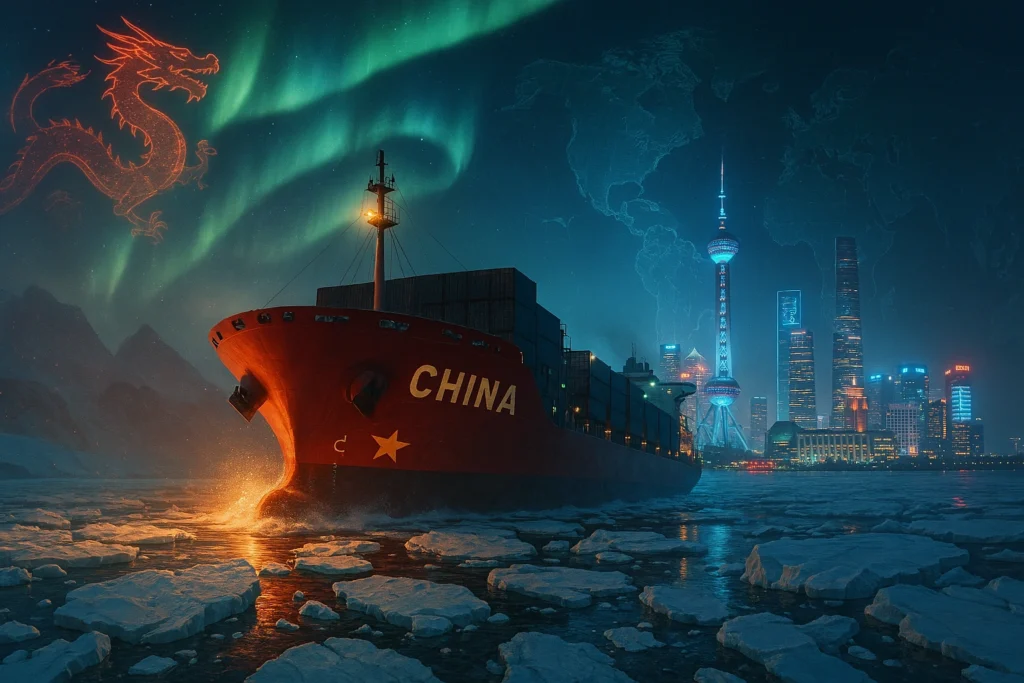
China’s approach is more patient but no less deliberate. Satellite imagery shows Chinese vessels have erected a floating barrier at the entrance to Scarborough Shoal, a disputed fishing reef within the Philippines’s exclusive economic zone. The deployment restricts Filipino access to the shoal, where Chinese coast guard and maritime militia vessels have long harassed Philippine boats — a broader pattern of gray-zone tactics to assert operational control over contested waters while staying below the threshold for armed conflict. Beijing doesn’t need to fire a shot. It needs only to demonstrate that it can throttle access. FDD
Why is the Strait of Hormuz so important to global oil supply? The Strait of Hormuz — a 21-mile-wide passage between Iran and Oman — carries roughly 20 million barrels of crude oil and petroleum products daily, representing approximately one-fifth of global consumption. No viable large-scale overland alternative exists for most Gulf producers. Its disruption spikes oil prices, triggers emergency reserve releases and sends inflationary shockwaves through supply chains worldwide.
The structural vulnerability runs deeper than any single strait. A study published in Nature Communications estimated that the expected value of trade at risk from chokepoint disruptions runs to $192 billion annually — and that baseline was calculated in the relative calm of recent years. The figure now looks conservative. What 2026 has revealed is that the probability assigned to worst-case scenarios was far too low. The actuarial tables for global trade need rewriting.
China’s naval ambition compounds the picture. China’s Liaoning aircraft carrier transited the Taiwan Strait on April 20, 2026, combined with the deployment of a PLAN task group into the Western Pacific — pointing to a broader strategic design: signaling resolve to Japan, countering the Philippines-US Balikatan exercises, and shaping the military balance ahead of possible high-level diplomacy with Washington. Each transit, each barrier, each mine-laying exercise is a demonstration of capability and a data point in a longer calculation. The Diplomat
The Second-Order Effects: Inflation, Food, and the Semiconductor Wildcard
The downstream consequences of the maritime chokepoints crisis are not limited to oil traders and freight companies. They flow directly into the price of bread.
Shipping and air disruptions slow trade, raise costs along supply chains, and hit tourism-dependent and import-reliant economies hardest — and consumers feel this through higher prices on food and essentials, with lower-income households bearing the largest share. An IMF working paper published earlier this year estimated that a 100-hour shipping delay raises inflation by roughly 0.5 percentage points at its five-month peak. The Hormuz disruption isn’t measured in hours. It’s been running for nearly three months, with no clear endpoint. International Monetary Fund
The Strait of Hormuz carries around a quarter of global seaborne oil trade and significant volumes of liquefied natural gas and fertilizers. Higher energy, fertiliser, and transport costs — including freight rates, bunker fuel prices, and insurance premiums — may increase food costs and intensify cost-of-living pressures, particularly for the most vulnerable. Countries in South Asia, sub-Saharan Africa, and the import-dependent economies of Southeast Asia face the most direct exposure. UNCTAD
Yet the deeper systemic risk isn’t hydrocarbons. It’s semiconductors. A Chinese air and sea blockade of Taiwan would prompt a 5% fall in global GDP, similar to the downturns of the 2008–09 global financial crisis and the COVID-19 pandemic, according to a Bloomberg forecast. Unlike oil — which can be drawn from strategic reserves, rerouted through pipelines, or substituted with alternative sources over time — chips can’t be stockpiled effectively. As Chatham House analysts noted in April, companies needing new chip sources must alter their software design and certification processes, which takes months or years. The Hormuz crisis is painful and recoverable. A Taiwan Strait crisis could be civilisationally disruptive. Chatham House
The Case That Chokepoints Are Less Decisive Than They Look
Still, the alarm demands scrutiny. There’s a long history of chokepoint crises that were supposed to bring civilisation to its knees — and didn’t.
Iran’s ability to sustain a full blockade of Hormuz is constrained by geography and economics it can’t wish away. Saudi Arabia has operated the East-West Abqaiq-Yanbu pipeline since the 1980s precisely to hedge this vulnerability: a 1,200-kilometre artery from the eastern oil fields to the Red Sea coast with a capacity of approximately 5 million barrels per day. The UAE has a comparable bypass through Fujairah. Neither replaces the full 20 million barrels per day transiting Hormuz, but they blunt the worst-case scenario.
The US military’s capacity to force the strait open, analysts long argued, was considerable. The Congressional Research Service, in its March 2026 assessment, noted that prior to Operation Epic Fury, there was broad consensus that American forces could restore shipping flows — though it acknowledged the timeline could stretch from days to months depending on what forms an Iranian closure attempt took. What no-one fully modelled was the dual blockade scenario: Iran closing the strait to outbound cargo simultaneously with the US closing it to inbound Iranian shipping. That combination has stretched the timeline and complicated the diplomatic exit ramp.
The Houthi campaign offers a cautionary parallel. Major carriers like Maersk returned to the Red Sea in late 2025 and early 2026, the first regular commercial voyages since the peak of attacks. The route didn’t die permanently. Yet this reopening remained tentative: other lines, including CMA CGM, continued to scale back Suez Canal sailings or reroute around Africa, reflecting ongoing security concerns. The lesson isn’t that chokepoints can’t be closed. It’s that the costs of closure are distributed unevenly, over time, and often invisibly — in shipping surcharges, insurance premiums, rerouting delays, and inflationary drips that governments struggle to attribute to a single cause. Eurasia Review
The Longer Reckoning
The power struggle in the world’s narrow seas is, at its core, a crisis of the architecture of globalisation. For 30 years, the assumption embedded in global supply chains — that the seas would remain open, that the rules-based maritime order would hold, that chokepoints were fixed features of geography and not tools of statecraft — underwrote trillions of dollars of investment, just-in-time manufacturing, and concentrated industrial geography. That assumption is now being actively contested by Iran, by the Houthis, and by a China that has spent two decades building the naval and gray-zone capacity to threaten it.
The Hormuz crisis will end — through negotiation, exhaustion, or military resolution. The Red Sea will partially stabilise. The Taiwan Strait will return to its baseline of managed tension. But the insurance markets, the rerouting patterns, and the capital allocation decisions made during these months won’t simply reverse. Ports in Fujairah and Duqm are being re-evaluated. The “Malacca Dilemma” that China’s strategists have long worried about is now matched by a Western reckoning with the vulnerability of its own trade arteries.
The narrow seas have always been where empires flex their will. The difference now is that more actors have enough capability to threaten them — and the global economy is tightly enough wound that the threat alone is enough to do damage.
The world spent a decade globalising its supply chains through the world’s most contested passages. The bill is coming due.